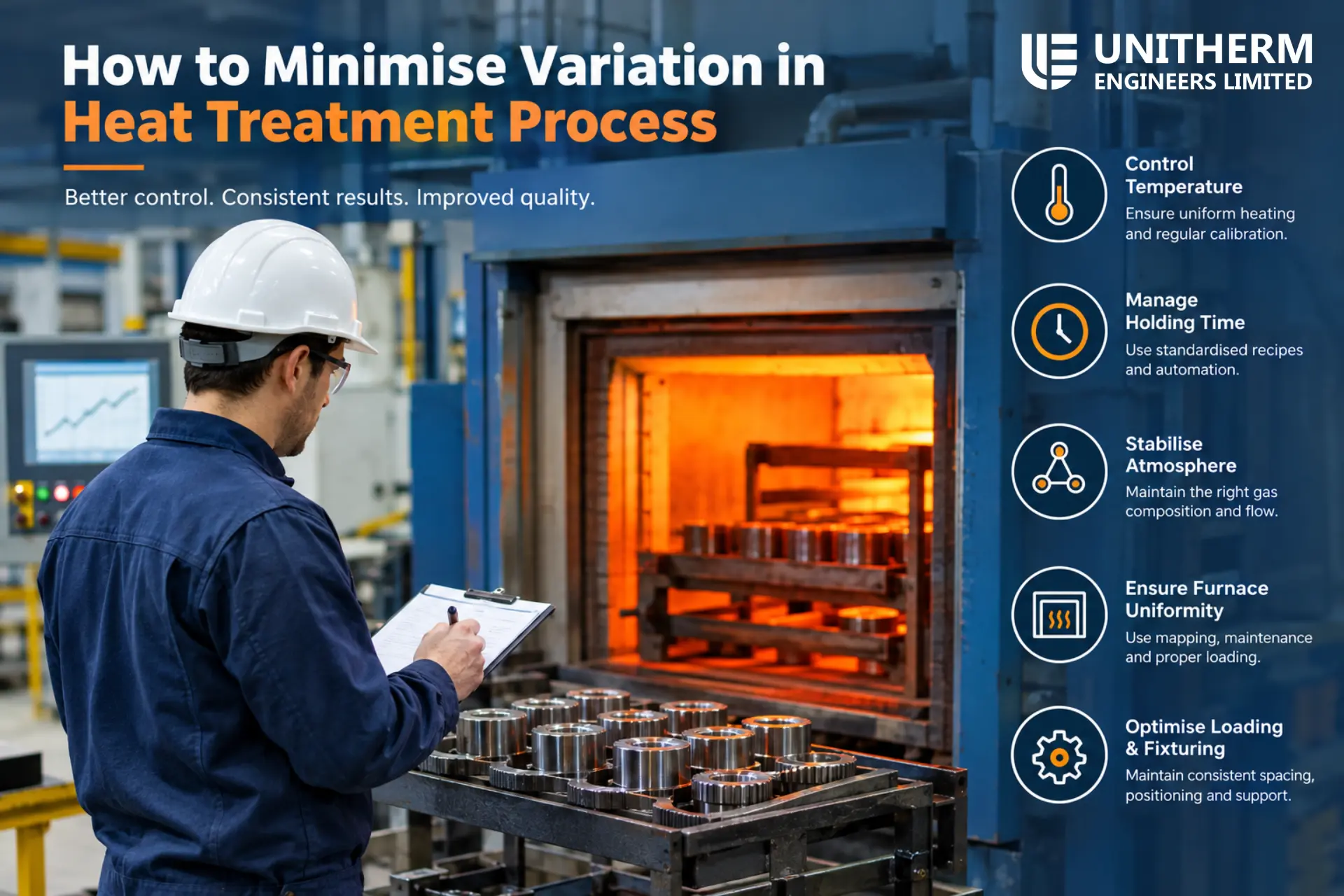
Consistent heat treatment is essential for producing metal components with predictable hardness, strength, microstructure, dimensional stability, and service life. However, achieving the same results from every batch can be challenging when multiple process variables influence the final properties of a component.
Heat Treatment Process Variation refers to differences in the results achieved between components, batches, or production cycles. Variations in furnace temperature, heating time, atmosphere, quenching conditions, material properties, fixturing, and equipment performance can all affect the final outcome.
For industries such as
automotive,
aerospace,
tooling, and precision engineering, uncontrolled variation can result in inconsistent hardness, distortion, dimensional inaccuracies, rejection, rework, and increased production costs. A systematic approach to process control can significantly improve consistency and reliability.
What is Heat Treatment Process Variation?
Heat Treatment Process Variation occurs when components subjected to the same intended heat treatment cycle produce different results.
Common examples include:
- Hardness variation
- Case depth variation
- Microstructural differences
- Dimensional variation
- Distortion
- Inconsistent surface condition
- Differences in mechanical properties
Some variation is naturally present in manufacturing. The objective is not necessarily to eliminate every variation, but to control it within acceptable limits and prevent uncontrolled process changes.
Major Causes of Heat Treatment Process Variation
Several factors can contribute to inconsistent heat treatment results.
1. Temperature Variation
Temperature is one of the
most important parameters in heat treatment. Differences between furnace zones, inaccurate sensors, incorrect heating rates, or poor furnace performance can result in inconsistent treatment.
Regular furnace calibration, temperature uniformity surveys, and proper maintenance help ensure that components receive the required thermal cycle.
2. Holding Time Variation
The time a component remains at the required temperature can directly influence its microstructure and mechanical properties.
Inconsistent holding or soaking times can affect:
- Hardness
- Case depth
- Grain growth
- Phase transformation
- Overall process consistency
Standardised heating recipes and automated controls can reduce operator-dependent variation.
3. Furnace Atmosphere Variation
For processes such as
carburizing and carbonitriding,
atmosphere control is particularly important.
Variables such as:
- Carbon potential
- Oxygen level
- Gas composition
- Gas flow
- Moisture
- Furnace sealing
can influence surface chemistry and case formation.
Controlled
Atmospheric Heat Treatment helps maintain stable processing conditions and achieve more consistent surface properties.
Importance of Furnace Temperature Uniformity
A furnace should provide consistent temperatures throughout the working zone. Significant temperature differences can cause different components—or different areas of the same component—to experience different thermal cycles.
Temperature uniformity can be improved through:
- Regular furnace calibration
- Temperature mapping
- Proper sensor maintenance
- Preventive equipment maintenance
- Correct furnace loading
- Appropriate component spacing
Maintaining uniform temperature is particularly important when treating precision components with tight hardness and dimensional requirements.
Role of Controlled Furnace Atmosphere
The
furnace atmosphere can have a significant influence on heat treatment results.
In carburizing, for example, maintaining the correct carbon potential helps achieve the desired surface carbon concentration and case depth.
Atmosphere control involves monitoring parameters such as:
- Carbon potential
- Gas flow
- Oxygen levels
- Furnace pressure
- Atmosphere composition
Consistent atmosphere conditions reduce variation in surface hardness, case depth, and microstructure.
Optimising Furnace Loading and Fixturing
How components are positioned inside the furnace can affect heat transfer, atmosphere circulation, and cooling.
Inconsistent loading may result in:
- Uneven heating
- Restricted gas circulation
- Different cooling rates
- Hardness variation
- Dimensional variation
Components should therefore be loaded using standardised arrangements with consistent spacing and orientation.
Customised fixturing in heat treatment can provide additional control by maintaining component positioning and supporting critical areas during heating and cooling. This is particularly useful for complex or distortion-sensitive components.
Standardising Heating and Holding Parameters
A consistent heat treatment process should have clearly defined parameters for:
- Heating rate
- Target temperature
- Holding time
- Atmosphere conditions
- Quenching parameters
- Tempering temperature and time
Standardised process recipes reduce dependence on individual operator decisions and make it easier to reproduce successful cycles.
Automated furnace controls can further improve consistency by maintaining predefined process parameters.
Controlling the Quenching Process
Quenching can have a major impact on hardness, microstructure, distortion, and residual stresses.
Important variables include:
- Quench temperature
- Cooling rate
- Agitation
- Gas pressure
- Oil condition
- Polymer concentration
If these conditions change from one batch to another, the resulting component properties may also change.
A controlled cooling strategy should therefore be developed based on the material, component geometry, required hardness, and dimensional requirements.
Equipment Calibration and Maintenance
Even a well-designed process can produce variation if the equipment is not maintained properly.
Important checks include:
- Furnace temperature sensors
- Heating elements
- Atmosphere sensors
- Gas flow systems
- Quenching systems
- Pressure controls
- Cooling equipment
Regular calibration and preventive maintenance help identify equipment problems before they affect production quality.
Process Monitoring and Data Collection
Consistent heat treatment requires reliable process data.
Manufacturers can monitor and record:
- Furnace temperature
- Heating and holding times
- Atmosphere conditions
- Quench parameters
- Hardness results
- Dimensional measurements
- Microstructure results
Recording data for every batch makes it easier to identify trends and detect gradual process drift.
For example, if hardness gradually decreases over several batches, process records can help determine whether the change is related to furnace temperature, atmosphere conditions, quenching performance, or material variation.
Quality Control and Testing
Quality checks should be performed before, during, and after heat treatment.
Before Treatment
- Verify material grade
- Check component dimensions
- Confirm material traceability
- Inspect surface condition
During Treatment
- Monitor temperature
- Monitor atmosphere
- Record cycle parameters
- Monitor quenching conditions
After Treatment
- Perform hardness testing
- Measure case depth where required
- Inspect dimensions
- Conduct microstructure analysis
- Check surface condition
This approach helps identify deviations early and supports continuous process improvement.
Standard Operating Procedures and Process Documentation
Standard Operating Procedures (SOPs) are important for maintaining repeatability.
An effective SOP should define:
- Material requirements
- Furnace loading arrangement
- Heating parameters
- Holding time
- Atmosphere settings
- Quenching conditions
- Tempering requirements
- Inspection criteria
Fixture arrangements and component orientation should also be documented when they have a significant impact on results.
How Technology Helps Minimise Variation
Modern heat treatment systems increasingly use automation and digital monitoring to improve consistency.
Technologies include:
Before Heat Treatment
- Automated furnace controls
- Digital temperature recording
- Automatic atmosphere control
- Real-time process monitoring
- Data logging
- Automated quench monitoring
- Industry 4.0 systems
These technologies reduce manual intervention and provide greater visibility into process performance.
Practical Checklist to Reduce Heat Treatment Variation
Manufacturers can use the following checklist:
- Verify the material grade.
- Maintain furnace temperature uniformity.
- Standardise heating and holding parameters.
- Monitor furnace atmosphere.
- Maintain consistent furnace loading.
- Inspect fixtures regularly.
- Control quenching conditions.
- Calibrate equipment periodically.
- Record process data.
- Perform post-treatment testing.
- Review batch-to-batch trends.
Benefits of Minimising Heat Treatment Process Variation
Better process control provides several benefits:
Examples include:
- Consistent hardness
- Uniform microstructure
- Improved dimensional stability
- Reduced distortion
- Lower rejection rates
- Less rework
- Reduced production costs
- Improved component reliability
- More predictable manufacturing performance
For high-volume production, even a small reduction in rejection or rework can provide significant operational and financial benefits.
Conclusion
Heat Treatment Process Variation can result from temperature fluctuations, inconsistent holding times, atmosphere changes, material differences, improper loading, quenching conditions, equipment performance, and inadequate process control.
RMinimising this variation requires a comprehensive approach. Consistent furnace conditions, controlled atmosphere, standardised heating cycles, appropriate fixturing, controlled cooling, equipment calibration, and systematic quality testing all contribute to repeatable results.
By monitoring the complete heat treatment cycle and using data to identify process trends, manufacturers can reduce variation, improve dimensional stability, minimise rejection, and achieve more consistent component performance.
Optimising furnace parameters, atmosphere control, quenching, cooling, and fixturing can significantly improve process repeatability. Consult experienced heat treatment specialists to evaluate your current process and develop a controlled solution based on your material, component geometry, and performance requirements.
FAQs
1.What is heat treatment process variation?
Heat Treatment Process Variation refers to differences in hardness, microstructure, case depth, dimensions, or other properties between components or production batches undergoing the same heat treatment process.
2.How can heat treatment process variation be minimised?
Variation can be reduced through consistent heating parameters, controlled furnace atmosphere, standardised furnace loading, proper fixturing, controlled quenching and cooling, regular equipment calibration, and systematic quality testing.
3.Why is furnace temperature uniformity important?
Furnace temperature uniformity ensures that components receive a consistent thermal cycle. Temperature differences within the furnace can result in variations in hardness, microstructure, case depth, and dimensional stability.
4.How does furnace atmosphere affect heat treatment consistency?
Controlled furnace atmosphere helps maintain consistent surface chemistry during processes such as carburizing and carbonitriding. Parameters such as carbon potential, gas composition, oxygen level, and gas flow can directly influence case depth and surface hardness.
5.Can customised fixturing reduce heat treatment variation?
Yes. Customised fixturing helps maintain consistent component positioning and orientation during heating and cooling. Proper fixture design can improve repeatability and reduce distortion, particularly for complex or precision components.