Heat treatment is an essential manufacturing process used to improve the hardness, strength, wear resistance, toughness, and service life of metal components. However, achieving the desired
metallurgical properties consistently requires more than simply following a predefined heating and cooling cycle.
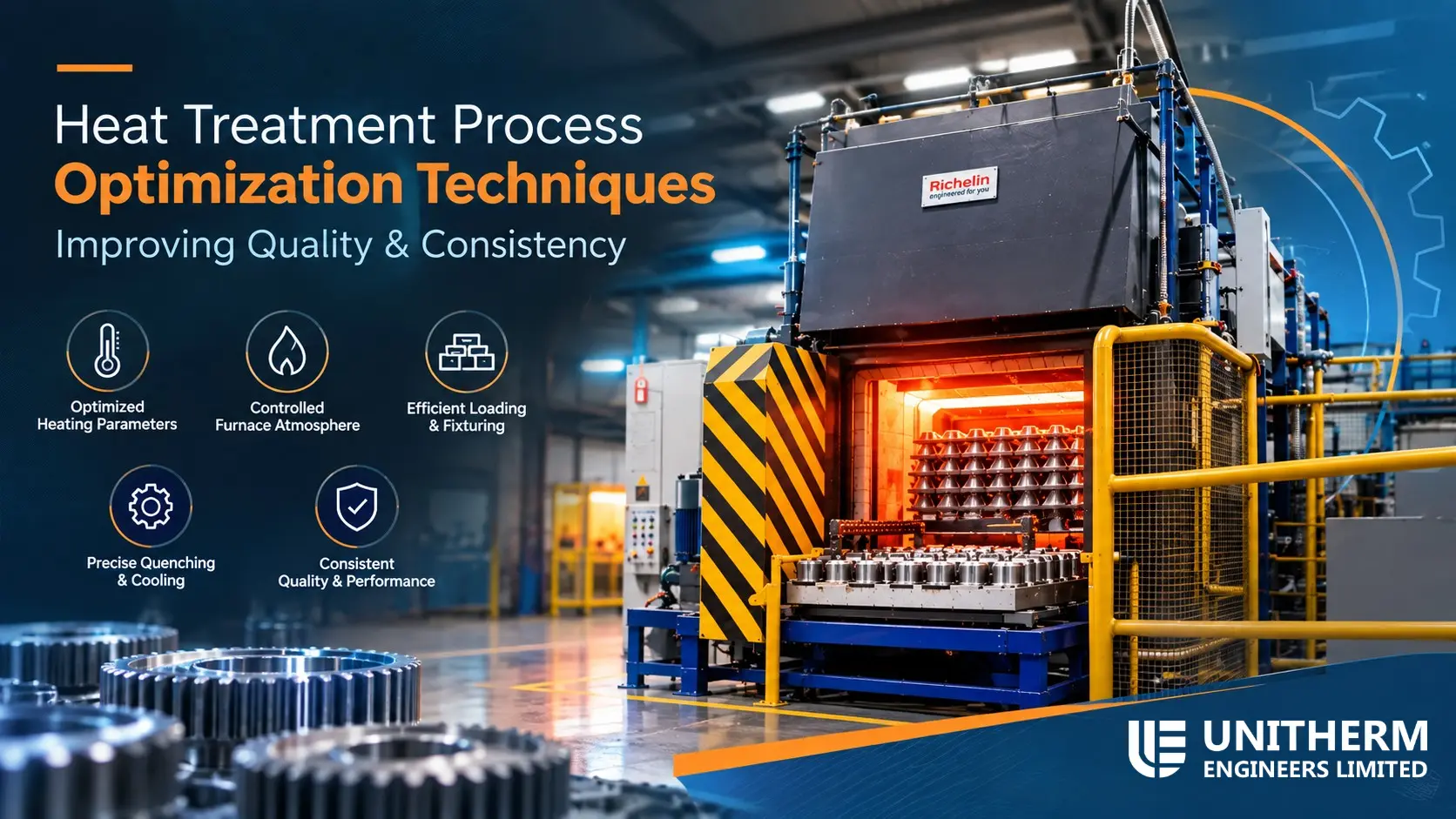
Heat Treatment Process Optimization involves systematically improving heating, soaking, furnace atmosphere, quenching, cooling, fixturing, equipment performance, and inspection parameters to achieve reliable and repeatable results.
An optimized process can help manufacturers reduce distortion, hardness variation, rejection, rework, energy consumption, and production costs while maintaining the required component performance. The right approach depends on factors such as material grade, component geometry, production volume, required hardness, dimensional tolerances, and end-use application.
What is Heat Treatment Process Optimization?
Heat Treatment Process Optimization is the systematic evaluation and improvement of heat treatment parameters to achieve the required metallurgical and dimensional results with greater consistency and efficiency.
The objective is to achieve the required:
- Hardness
- Microstructure
- Case depth
- Dimensional accuracy
- Surface condition
- Mechanical properties
- Process repeatability
At the same time, optimization should consider productivity, energy consumption, rejection rates, and overall processing costs.
An effective optimization strategy looks at the complete process rather than changing only one parameter.
Key Parameters That Require Optimization
Several interconnected parameters influence heat treatment results, including:
- Heating rate
- Treatment temperature
- Holding or soaking time
- Furnace atmosphere
- Carbon potential
- Furnace loading
- Quenching conditions
- Cooling rate
- Fixturing
- Tempering parameters
- Equipment condition
- Inspection and testing
Changes in one parameter can influence another. For this reason, process optimization should be approached systematically.
Optimizing Heating Parameters
Heating conditions have a direct influence on microstructure and dimensional stability.
Heating Rate
The heating rate should be appropriate for the material and component geometry. Excessively rapid heating can create temperature differences between the surface and core, potentially increasing thermal stresses.
Treatment Temperature
Accurate temperature control is essential. Under heating may result in insufficient transformation or hardness, while overheating can contribute to grain growth and unwanted dimensional changes.
Holding Time
The component must remain at the required temperature for sufficient time to achieve uniform heating and the desired metallurgical transformation. Excessive holding, however, can increase energy consumption and may negatively affect the material.
Optimizing these parameters helps create a repeatable thermal cycle.
Furnace Atmosphere Optimization
Furnace atmosphere is particularly important for processes such as carburizing, carbonitriding, annealing, and hardening.
Important parameters include:
- Carbon potential
- Oxygen level
- Gas composition
- Gas flow
- Furnace pressure
- Furnace sealing
For carburizing applications, maintaining the appropriate carbon potential helps achieve the required case depth and surface properties.
Controlled
Atmospheric Heat Treatment can provide consistent processing conditions while helping manage surface reactions such as oxidation and decarburization.
Furnace Loading and Component Positioning
The way components are arranged inside a furnace can affect heating, atmosphere circulation, and cooling.
Overcrowding can restrict heat and gas circulation, while inconsistent spacing may result in differences in thermal exposure between components.
Optimized furnace loading should consider:
- Component spacing
- Orientation
- Batch size
- Component geometry
- Fixture arrangement
- Gas circulation
- Cooling access
A standardised loading pattern can reduce batch-to-batch variation and improve process repeatability.
Role of Customised Fixturing
Fixturing is another important element of heat treatment process optimization.
- Maintain component orientation
- Support critical areas
- Reduce bending and warping
- Improve cooling access
- Improve repeatability
- Maintain dimensional stability
Fixtures should provide adequate support without excessively restricting natural thermal expansion and contraction.
For complex components, fixture design should be considered during process planning rather than treated simply as a loading requirement.
Quenching and Cooling Optimization
Quenching has a significant influence on hardness, microstructure, distortion, and residual stresses.
Depending on the material and application, manufacturers may use:
- Oil quenching
- Gas cooling
- Polymer quenching
- Air cooling
- Other controlled cooling methods
Important parameters include:
- Cooling rate
- Quench-medium temperature
- Agitation
- Gas pressure
- Flow rate
- Cooling-medium condition
The objective is to achieve the required metallurgical transformation without introducing unnecessary thermal or transformation stresses.
This makes
controlled cooling in heat treatment an important part of dimensional stability and distortion control.
Distortion Control as Part of Process Optimization
Distortion should be addressed during
heat treatment process design rather than corrected after treatment.
Potential forms of distortion include:
- Bending
- Warping
- Twisting
- Ovality
- Dimensional changes
The complete process should therefore be evaluated from:
Heating → Holding → Transformation → Quenching → Cooling → Final Dimensions
Component geometry, material properties, furnace loading, fixturing, and cooling conditions should all be considered together.
Understanding the causes of distortion during heat treatment can help manufacturers identify opportunities for process improvement.
Reducing Heat Treatment Process Variation
Variation can occur because of:
- Furnace temperature differences
- Material inconsistencies
- Atmosphere fluctuations
- Quench conditions
- Furnace loading
- Fixture changes
- Equipment condition
- Operator-dependent settings
Standardized process recipes and documented operating procedures can reduce these variations.
Manufacturers should establish defined parameters for temperature, heating rate, holding time, atmosphere, quenching, cooling, and inspection.
Regular review of batch data can also help identify gradual process drift.
Equipment Calibration and Preventive Maintenance
Reliable equipment is essential for a
stable heat treatment process.
Important maintenance activities include:
- Temperature sensor calibration
- Furnace temperature mapping
- Heating element inspection
- Atmosphere sensor calibration
- Gas flow checks
- Quench system inspection
- Pressure monitoring
- Preventive maintenance
Equipment performance can change over time. Regular calibration and maintenance help ensure that actual process conditions remain aligned with the specified parameters.
Process Monitoring and Data Analysis
Process data provides valuable information for optimization.
Manufacturers can record:
- Furnace temperature
- Heating rate
- Holding time
- Atmosphere conditions
- Quench parameters
- Cooling rate
- Hardness
- Case depth
- Dimensional measurements
- Microstructure results
Comparing this information across batches can help identify trends and determine the root causes of variation.
Statistical Process Control (SPC) can also be used where appropriate to monitor process capability and identify abnormal variation before it becomes a major quality issue.
Quality Testing and Validation
Optimization changes should always be validated through appropriate testing.
Before Heat Treatment
- Material verification
- Grade confirmation
- Dimensional inspection
- Traceability checks
During Treatment
- Temperature monitoring
- Atmosphere monitoring
- Process parameter recording
After Treatment
- Hardness testing
- Case depth measurement
- Microstructure analysis
- Dimensional inspection
- Surface inspection
Testing confirms whether the optimized process is delivering the required results.
Energy and Cost Optimization
Process optimization can also improve operational efficiency.
Manufacturers can reduce unnecessary costs by:
- Optimizing holding times
- Improving furnace loading
- Reducing rejected components
- Minimizing rework
- Improving cycle efficiency
- Maintaining furnace performance
- Avoiding unnecessary energy consumption
However, cost reduction should never compromise the required hardness, microstructure, dimensional accuracy, or component performance.
Technology in Heat Treatment Process Optimization
Modern
heat treatment operations increasingly use automation and digital monitoring.
Examples include:
- Automated furnace controls
- Digital temperature recording
- Automatic atmosphere control
- Real-time process monitoring
- Data logging
- Automated quenching systems
- Predictive maintenance
- Industry 4.0 integration
These technologies can reduce manual errors, improve traceability, and provide better control over process parameters.
Practical Heat Treatment Optimization Checklist
Manufacturers can follow a structured approach:
- 1. Verify material and component requirements.
- 2. Optimize the heating rate and treatment temperature.
- 3. Establish appropriate holding times.
- 4. Maintain furnace temperature uniformity
- 5. Control the furnace atmosphere.
- 6. Standardize furnace loading.
- 7. Optimize fixture design.
- 8. Control quenching and cooling conditions.
- 9. Calibrate equipment regularly.
- 10. Record and analyse process data.
- 11. Validate hardness, microstructure, and dimensions.
- 12. Continuously review batch-to-batch performance.
Benefits of Heat Treatment Process Optimization
A properly optimized process can provide:
- Improved hardness consistency
- Controlled microstructure
- Better dimensional stability
- Reduced distortion
- Lower rejection rates
- Less rework
- Improved productivity
- Reduced process variation
- Better energy efficiency
- Lower manufacturing costs
- Improved component reliability
These benefits are particularly valuable in industries where components must meet strict dimensional and metallurgical specifications.
Conclusion
Heat Treatment Process Optimization is a continuous approach that combines controlled heating, accurate temperature management, furnace atmosphere control, appropriate fixturing, optimized quenching, controlled cooling, equipment maintenance, and systematic quality monitoring.
Rather than focusing on a single parameter, manufacturers should evaluate the complete heat treatment cycle and its effect on material properties, dimensional stability, productivity, and cost.
With the right combination of process control and data-driven improvement, manufacturers can reduce distortion and variation while achieving more consistent hardness, microstructure, and component performance.
Our heat treatment specialists can help evaluate heating, atmosphere, quenching, cooling, fixturing, and quality parameters based on your component material, geometry, and performance requirements. Contact us to discuss your heat treatment application and develop a more consistent and efficient process.
FAQs – Heat Treatment Process Optimization Techniques
1.What is heat treatment process optimization?
Heat Treatment Process Optimization is the systematic improvement of heating, temperature, holding time, furnace atmosphere, quenching, cooling, fixturing, and inspection parameters to achieve consistent metallurgical and dimensional results.
2.Why is heat treatment process optimization important?
Heat treatment process optimization helps improve hardness consistency, microstructure, dimensional stability, and component performance while reducing distortion, rejection, rework, energy consumption, and production costs.
3.How does furnace temperature affect heat treatment results?
Inconsistent furnace temperature can cause differences in heating and transformation across components. Maintaining temperature uniformity helps achieve consistent hardness, microstructure, and dimensional properties.
4.How does atmosphere control improve heat treatment?
Controlled furnace atmosphere helps maintain consistent surface chemistry during processes such as carburizing and carbonitriding. Monitoring carbon potential, oxygen levels, gas composition, and gas flow can improve case depth and surface-property consistency.
5.Can heat treatment process optimization reduce distortion?
Yes. Optimizing heating, quenching, cooling, furnace loading, and fixturing can help reduce thermal gradients and transformation stresses, thereby improving dimensional stability and reducing bending, warping, and other forms of distortion.
6.What role does customised fixturing play in heat treatment optimization?
Customised fixturing helps maintain component positioning, support critical areas, and provide consistent heating and cooling conditions. Proper fixture design can improve repeatability and reduce distortion, especially for complex components.