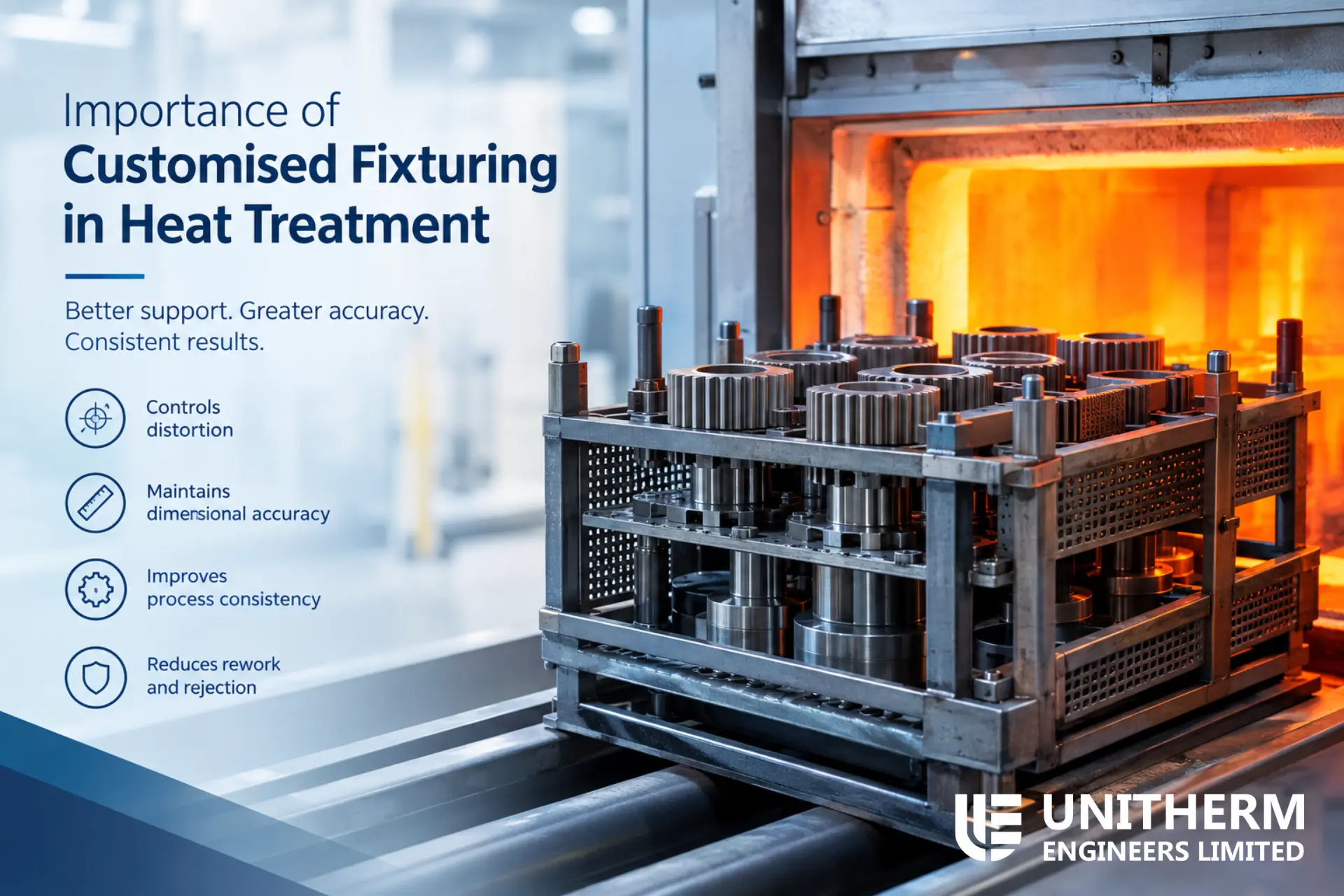
Heat treatment is a critical manufacturing process used to improve the hardness, strength, wear resistance, and durability of metal components. However, achieving the desired metallurgical properties is only one part of a successful heat treatment cycle. Maintaining dimensional accuracy and controlling distortion are equally important, particularly for components manufactured to tight tolerances.
During heating, quenching, and cooling, components can expand, contract, or undergo phase transformations. If they are not adequately supported, these changes can result in bending, warping, twisting, or other dimensional variations. This is where
Customised Fixturing in Heat Treatment becomes important.
Custom-designed fixtures provide appropriate support and positioning for components throughout the heat treatment cycle. They help control component movement while allowing suitable thermal expansion and contraction, improving consistency and reducing the need for costly post-treatment corrections.
What is Fixturing in Heat Treatment?
Fixturing refers to the use of specially designed supports, frames, baskets, racks, or holding devices to position components during a heat treatment process.
A fixture is designed to:
- Hold components in the correct position
- Maintain component orientation
- Provide adequate support
- Reduce unnecessary movement
- Allow proper heating and cooling
- Improve batch-to-batch consistency
Standard fixtures may work effectively for simple components. However, complex, thin, long, or precision-engineered components often require a fixture designed specifically around their geometry and
heat treatment requirements.
Customised Fixturing in Heat Treatment considers the component's dimensions, material, shape, process temperature, quenching method, and critical tolerances.
Why is Customised Fixturing Important?
Heat treatment involves significant thermal and mechanical changes. Without appropriate support, components can experience dimensional changes that affect their final performance.
Customised fixtures help manufacturers:
- Minimise distortion
- Maintain dimensional accuracy
- Control component movement
- Improve heating and cooling uniformity
- Maintain correct component alignment
- Improve process repeatability
- Reduce rejection and rework
For precision components, even small dimensional changes can make a part unsuitable for its intended application. Proper fixturing therefore becomes an important part of overall process control.
Distortion can occur due to several physical and metallurgical factors.
Thermal Expansion and Contraction
When a component is heated, it expands. During cooling, it contracts. Uneven temperature distribution can cause different sections to expand or contract at different rates.
Phase Transformations
Some steels undergo changes in their crystal structure during heating and cooling. These transformations can produce dimensional changes and internal stresses.
Quenching Stresses
Rapid cooling can generate significant thermal and transformation stresses. If these stresses are unevenly distributed, they can cause bending or warping.
Component Geometry
Thin sections, long shafts, irregular shapes, holes, and uneven cross-sections are generally more susceptible to distortion.
Properly designed fixtures help manage these effects by supporting critical areas throughout the process.
Role of Customised Fixturing in Distortion Control
One of the primary purposes of customised fixturing is to reduce unwanted dimensional changes.
A well-designed fixture provides controlled support at strategic points without unnecessarily restricting the component's natural thermal movement.
It can help:
- Prevent bending
- Reduce twisting
- Maintain alignment
- Support thin sections
- Stabilise long components
- Preserve critical dimensions
However, excessive restraint should also be avoided. A fixture that holds a component too rigidly can introduce additional stresses during thermal expansion and contraction. Effective fixture design therefore requires a balance between support and controlled movement.
Customised Fixturing for Complex Components
Complex components often have different thicknesses, irregular geometries, or critical functional surfaces. These characteristics can make them more vulnerable to distortion.
Examples include:
Gears
Fixtures can maintain gear orientation and provide appropriate support during
heating and quenching.
Shafts
Long shafts can be susceptible to bending. Proper support helps maintain straightness.
Dies and Molds
Precision tooling often requires tight dimensional control, making appropriate
fixture design essential.
Automotive Components
Transmission parts, axles, and other drivetrain components can benefit from application-specific fixtures.
Thin Components
Thin sections can deform easily during rapid heating and cooling and may require carefully positioned supports.
Important Fixture Design Considerations
Effective
Customised Fixturing in Heat Treatment requires consideration of several factors.
Component Geometry
The fixture should account for the component's length, thickness, shape, holes, weight, and critical dimensions.
Material Properties
Different materials respond differently to heating and cooling. Thermal expansion and transformation characteristics should be considered during fixture design.
Heat Treatment Process
The fixture should be designed according to the specific process, such as carburizing, hardening, annealing, nitriding, or tempering.
Heating and Cooling Method
Gas quenching, oil quenching, and controlled cooling create different thermal conditions. Fixture design must accommodate the selected cooling method.
Support Locations
Supports should be positioned at locations that provide stability while avoiding unnecessary restriction of thermal movement.
Customised Fixturing and Uniform Heat Treatment
Fixtures should support the component without interfering with heat transfer or cooling.
Poor fixture design can block
furnace atmosphere or quenching media from reaching certain surfaces. This may result in uneven
heating or cooling and inconsistent metallurgical properties.
Good fixture design should therefore provide:
- Appropriate component spacing
- Adequate gas circulation
- Uniform furnace atmosphere exposure
- Proper cooling access
- Minimal contact between critical surfaces
This helps ensure that components receive consistent treatment throughout the
heat treatment cycle .
Benefits of Customised Fixturing in Heat Treatment
Investing in application-specific fixtures can provide several manufacturing benefits.
Improved Dimensional Stability
Proper support reduces unwanted deformation during thermal processing.
Reduced Distortion
Strategic fixture placement helps control bending, twisting, and warping.
Better Process Repeatability
Consistent loading and positioning improve batch-to-batch results.
Lower Rejection Rates
Better dimensional control reduces the number of components that fail inspection.
Reduced Post-Treatment Machining
Maintaining closer dimensions can reduce grinding, straightening, or corrective machining requirements.
Improved Productivity
Fewer rejected components and less rework can improve overall production efficiency.
Customised Fixturing vs Standard Fixtures
| Factor |
Standard Fixture |
Customised Fixture |
| Component Compatibility |
General |
Application-specific |
| Distortion Control |
Limited |
Optimised |
| Dimensional Accuracy |
Moderate |
High |
| Complex Components |
Limited suitability |
Better suited |
| Process Repeatability |
Standard |
Improved |
Standard fixtures may be sufficient for simple and repetitive components. For complex or precision-critical applications, customised solutions can provide greater control.
Common Fixturing Challenges
Even customised fixtures need proper design and maintenance.
Common challenges include:
- Incorrect support locations
- Excessive component restraint
- Poor gas circulation
- Fixture deformation
- Inadequate fixture strength
- Improper component loading
- Fixture wear over repeated cycles
Regular inspection and maintenance are important to ensure that fixtures continue to perform as intended.
Manufacturers can improve fixturing performance by following several practices:
- Analyse component geometry before designing the fixture.
- Identify critical dimensions and surfaces.
- Consider thermal expansion and transformation behaviour
- Provide sufficient heating and cooling access.
- Select suitable fixture materials.
- Validate the fixture through trial batches.
- Inspect fixtures regularly for wear or deformation.
- Review fixture design when component or process parameters change.
Combining effective fixture design with controlled heating, quenching, and cooling can significantly improve heat treatment consistency.
Applications Across Industries
Customised fixturing is valuable across multiple manufacturing sectors.
Automotive
Used for gears, shafts, axles, and transmission components.
Tool and Die
Supports dies, molds, punches, and other precision tooling.
Aerospace
Helps maintain tight dimensional tolerances for critical components.
General Engineering
Used for bearings, rollers, shafts, and other precision machine components.
Conclusion
Customised Fixturing in Heat Treatment is an important factor in achieving dimensional stability, process consistency, and reliable component performance. While heating and cooling parameters determine many of the metallurgical properties of a component, proper fixturing helps ensure that the component maintains its intended geometry throughout the process.
By considering component geometry, material characteristics, thermal behaviour, support locations, and cooling requirements, manufacturers can minimise distortion, reduce rejection, and limit post-treatment machining.
For complex and precision components, customised fixturing should be considered an integral part of the heat treatment strategy rather than simply a method of loading components into a furnace.
The right fixture design can make a significant difference in dimensional accuracy and process consistency. Consult experienced heat treatment specialists to develop a customised fixturing solution based on your component geometry, material, and heat treatment requirements.
FAQs
1.What is customised fixturing in heat treatment?
Customised fixturing in heat treatment involves designing specialised fixtures to hold, support, and position components during heating, quenching, and cooling. The fixture is designed according to the component's geometry, material, dimensions, and heat treatment requirements.
2.Why is customised fixturing important in heat treatment?
Customised fixturing helps control component movement and distortion during thermal processing. It can improve dimensional accuracy, process consistency, component alignment, and repeatability while reducing rejection and post-treatment machining.
3.How does customised fixturing reduce heat treatment distortion?
Customised fixtures provide controlled support at critical locations while allowing appropriate thermal expansion and contraction. This helps minimise bending, twisting, warping, and other unwanted dimensional changes during heating and cooling.
4.Which components require customised heat treatment fixtures?
Customised fixtures are particularly useful for complex, thin, long, or precision components such as:
- Gears
- Shafts
- Dies and molds
- Automotive components
- Axles
- Bearings
- Precision machine components
5.Can customised fixturing improve dimensional accuracy?
Yes. Proper fixture design helps maintain component orientation and geometry throughout the heat treatment cycle. This can improve dimensional stability and reduce the need for corrective machining or straightening.