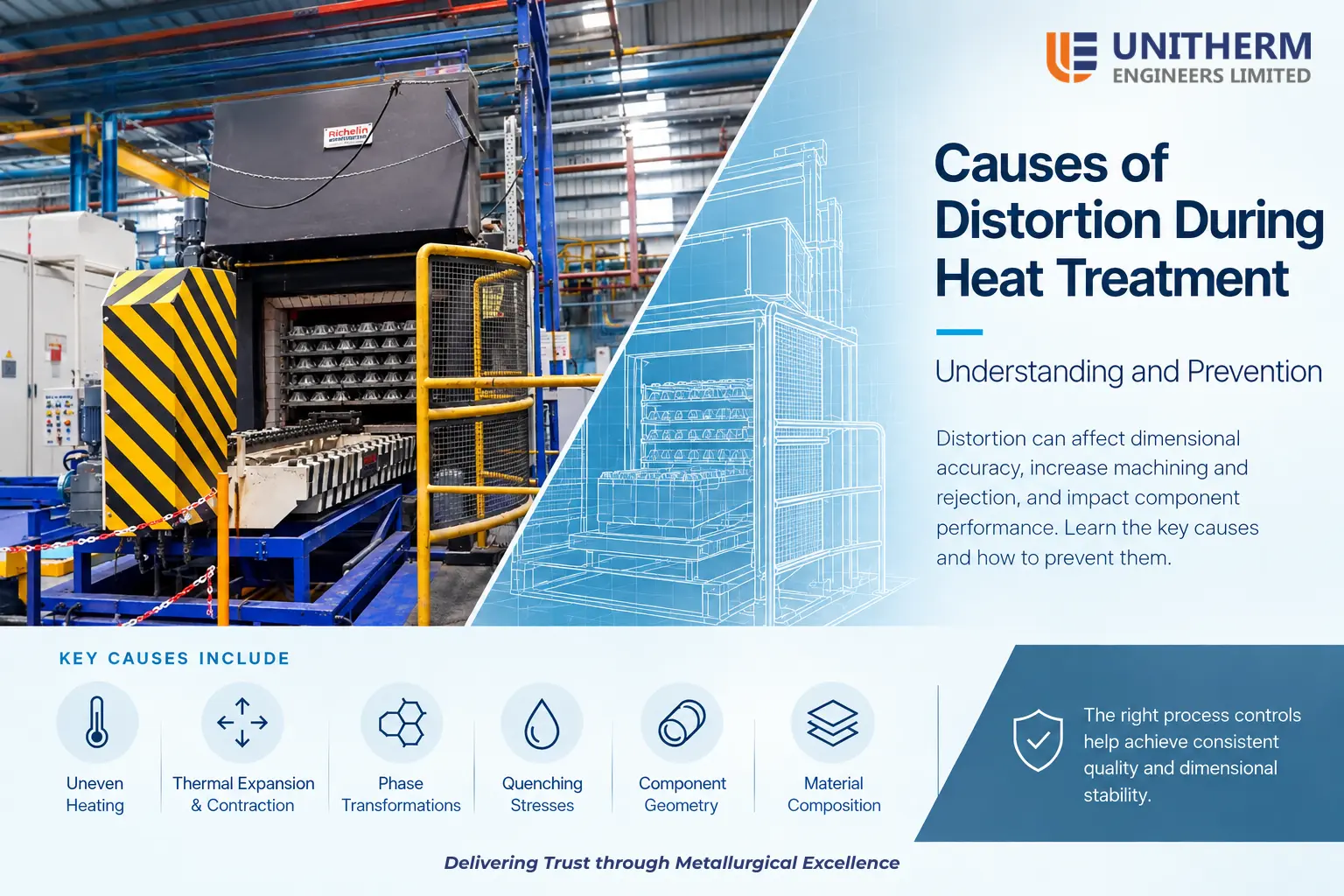
Heat treatment is widely used to improve the hardness, strength, wear resistance, and fatigue performance of metal components. However, achieving the required metallurgical properties can sometimes result in unwanted dimensional changes.
Distortion During Heat Treatment is a common manufacturing challenge, particularly for components with complex geometries, tight tolerances, or uneven cross-sections.
Distortion can occur during heating, holding, quenching, or cooling because of thermal expansion, phase transformations, residual stresses, and uneven cooling. If not properly controlled, it can lead to dimensional inaccuracies, additional machining, component rejection, and increased production costs.
Understanding the causes of
heat treatment distortion and applying appropriate process controls can help manufacturers achieve consistent component quality and dimensional stability..
What is Distortion During Heat Treatment?
Distortion During Heat Treatment refers to unwanted changes in the shape, dimensions, or geometry of a component during or after a heat treatment cycle.
Common forms of distortion include:
- Bending
- Warping
- Twisting
- Ovality
- Changes in flatness
- Uneven shrinkage or expansion
- Changes in diameter or length
Distortion is different from simple dimensional change. While all materials may expand or contract during heating and cooling, distortion occurs when these changes are uneven across the component.
For precision components, even a small dimensional variation can affect assembly, performance, and service life.
Major Causes of Distortion During Heat Treatment
Several interconnected factors can contribute to heat treatment distortion.
1.Uneven Heating
Uneven heating is one of the major causes of distortion. Different sections of a component may reach the required temperature at different rates because of variations in thickness, geometry, furnace positioning, or material properties.
When one area expands faster than another, internal stresses can develop. These stresses may result in bending or deformation.
Proper furnace temperature uniformity, suitable heating rates, and correct component spacing can help reduce this problem.
Metal components expand when heated and contract as they cool.
If all areas of a component expand and contract uniformly, dimensional changes can generally be controlled. However, complex geometries and uneven cross-sections can cause different areas to respond differently.
For example, a thin section may heat and cool more quickly than a thicker section. This difference can create internal stresses and contribute to warping or dimensional variation.
3. Phase Transformations
Heat treatment can cause changes in the microstructure of steel.
During heating, steel may transform into austenite. During cooling, austenite can transform into phases such as martensite, depending on the cooling rate and material composition.
These transformations can involve changes in volume. If transformation occurs unevenly throughout a component, it can generate internal stresses and contribute to distortion.
Therefore, understanding the material's transformation behaviour is essential when designing a
heat treatment cycle .
4. Quenching Stresses
Quenching is often necessary to achieve the desired hardness, but rapid cooling can create significant thermal and transformation stresses.
Different parts of a component may cool at different rates. The surface may cool much faster than the core, creating stress between the two regions.
The severity of the quenching process also affects distortion.
Common quenching methods include:
- Oil quenching
- Water-based quenching
- Polymer quenching
- Gas quenching
Selecting the appropriate quenching medium and cooling rate helps balance hardness requirements with dimensional stability.
5. Component Geometry
Component design has a major influence on distortion.
Parts that are particularly sensitive include:
- Long shafts
- Thin sections
- Rings
- Asymmetrical components
- Components with holes
- Parts with varying cross-sections
- Complex dies and molds
For example, a long shaft may bend during heating and cooling, while a thin component may warp because of rapid temperature changes.
Understanding component geometry before selecting the
heat treatment process is therefore essential.
6. Material Composition
Different steel grades respond differently to heat treatment.
Factors such as:
- Carbon content
- Alloying elements
- Hardenability
- Grain structure
- Transformation characteristics
can influence the level of distortion produced during processing.
Two components with identical dimensions may behave differently if they are manufactured from different steel grades.
Material selection and process parameters should therefore be considered together.
7. Residual Stresses Before Heat Treatment
Residual stresses can already exist in components before they enter the furnace.
Manufacturing processes such as:
- Forging
- Casting
- Welding
- Machining
- Cold forming
can introduce internal stresses.
When the component is heated, these stresses may be released or redistributed, resulting in dimensional changes.
Where appropriate, stress relieving before the final hardening process can help reduce this source of distortion.
Quenching conditions have a significant influence on dimensional stability.
Very rapid cooling can produce high thermal gradients and transformation stresses. However, reducing the cooling rate too much may prevent the component from achieving the required hardness.
The objective is therefore not simply to achieve the fastest possible cooling, but to select a controlled cooling strategy that provides the required metallurgical properties while limiting distortion.
Process parameters such as quench temperature, agitation, cooling medium, and component orientation should be carefully controlled.
Role of Fixturing in Distortion Control
Proper
fixturing can significantly improve dimensional stability during heat treatment.
Fixtures help:
- Position components correctly
- Support critical areas
- Maintain alignment
- Reduce unwanted movement
- Control bending and warping
For complex or precision components,
customised fixturing in heat treatment can provide application-specific support.
However, fixtures should not completely restrict natural thermal expansion and contraction. Excessive restraint can introduce additional stresses and potentially increase distortion.
The fixture should therefore provide controlled support while allowing appropriate thermal movement.
Impact of Furnace Conditions
Furnace conditions also influence distortion.
Important factors include:
- Temperature uniformity
- Heating rate
- Furnace loading
- Component spacing
- Atmosphere control
- Holding time
Overloading a furnace or placing components too closely together can affect heat circulation and result in uneven heating.
Proper furnace loading and process monitoring help maintain consistent treatment conditions across the batch.
Common Components Prone to Distortion
Some components require additional process planning because of their geometry or application requirements.
Automotive Components
Gears, shafts, transmission components, and axles can be sensitive to distortion because of their tight dimensional requirements.
Tooling
Dies, molds, punches, and cutting tools often require high dimensional accuracy after hardening.
Shafts and Rings
Long shafts can bend, while rings may develop ovality or changes in roundness.
Thin Components
Thin sections can experience rapid heating and cooling, increasing the risk of warping.
Uncontrolled distortion can have several consequences:
- Dimensional inaccuracies
- Increased rejection rates
- Additional grinding
- Straightening requirements
- Increased machining costs
- Assembly difficulties
- Production delays
In critical applications, dimensional distortion can also affect component performance and service reliability.
How to Minimise Distortion During Heat Treatment
Manufacturers can reduce distortion through a combination of process and design controls:
- Use uniform and controlled heating.
- Optimise heating and holding cycles.
- Select an appropriate quenching medium.
- Control cooling rates and agitation.
- Use customised fixturing where required.
- Consider stress relieving before hardening.
- Optimise furnace loading and component spacing.
- Select suitable materials and grades.
- Monitor furnace and quenching parameters.
- Perform dimensional inspection before and after treatment.
Process validation and trial batches can also help identify potential distortion issues before full-scale production.
Importance of Process Monitoring
Consistent monitoring is essential for controlling distortion.
Manufacturers can use:
- Furnace temperature monitoring
- Quench monitoring
- Hardness testing
- Dimensional inspection
- Metallurgical analysis
- Process documentation
Comparing dimensional results before and after heat treatment can help identify patterns and determine the root cause of distortion.
A data-driven approach also improves batch-to-batch consistency.
Heat Treatment Process Optimisation
Distortion control should be considered during the complete process design rather than after a component has already been treated.
Important optimisation areas include:
- Heating rate
- Soaking time
- Furnace atmosphere
- Quenching severity
- Controlled cooling
- Fixture design
- Furnace loading
Optimising these parameters together can improve dimensional stability while maintaining the required hardness and microstructure.
Conclusion
Distortion During Heat Treatment can result from several factors, including uneven heating, thermal expansion and contraction, phase transformations, quenching stresses, component geometry, material composition, and pre-existing residual stresses.
Although distortion cannot always be eliminated completely, it can be significantly reduced through appropriate process design and control. Uniform heating, controlled cooling, customised fixturing, suitable quenching conditions, stress relieving, and accurate process monitoring all contribute to better dimensional stability.
For manufacturers producing precision gears, shafts, automotive components, dies, molds, and other critical parts, proactive distortion control can reduce rejection, machining requirements, and production costs while improving overall component quality and reliability.
Looking to minimise distortion in your heat treatment process? An experienced heat treatment specialist can evaluate your component material, geometry, heating cycle, quenching method, and fixturing requirements to develop an optimised process for consistent results.
FAQs
1.What is distortion during heat treatment?
Distortion During Heat Treatment refers to unwanted changes in the shape, dimensions, or geometry of a metal component during heating, quenching, or cooling. Common examples include bending, warping, twisting, ovality, and changes in flatness.
2.How does quenching cause distortion?
During quenching, different areas of a component may cool at different rates. Rapid cooling creates thermal and transformation stresses, which can result in bending, warping, cracking, or dimensional changes.
3.Does component geometry affect heat treatment distortion?
Yes. Long shafts, thin sections, rings, asymmetrical components, and parts with varying cross-sections are generally more susceptible to distortion because they can heat and cool unevenly.
4.How do phase transformations cause distortion?
During heat treatment, steel can transform between different microstructures. For example, the transformation of austenite to martensite can involve a volume change. If the transformation occurs unevenly, internal stresses and dimensional changes can develop.
5.Can customised fixturing reduce heat treatment distortion?
Yes. Properly designed customised fixturing can support critical areas, maintain component alignment, and control unwanted movement during heating and cooling. However, fixtures should allow appropriate thermal expansion and contraction rather than excessively restraining the component.
6.How does surface hardening improve fatigue strength?
Many surface hardening processes create compressive residual stresses and hardened microstructures that help prevent crack initiation and propagation. This significantly improves fatigue resistance under repeated loading conditions.