Wear is one of the most common causes of component failure in industrial applications. Parts that operate under continuous friction, contact stress, and heavy loads gradually lose material from their surfaces, leading to reduced efficiency, increased maintenance costs, and premature equipment failure. To combat these challenges, manufacturers rely on
advanced heat treatment techniques that enhance surface durability without compromising the toughness of the component core.
One of the most effective solutions is
Case Hardening. This
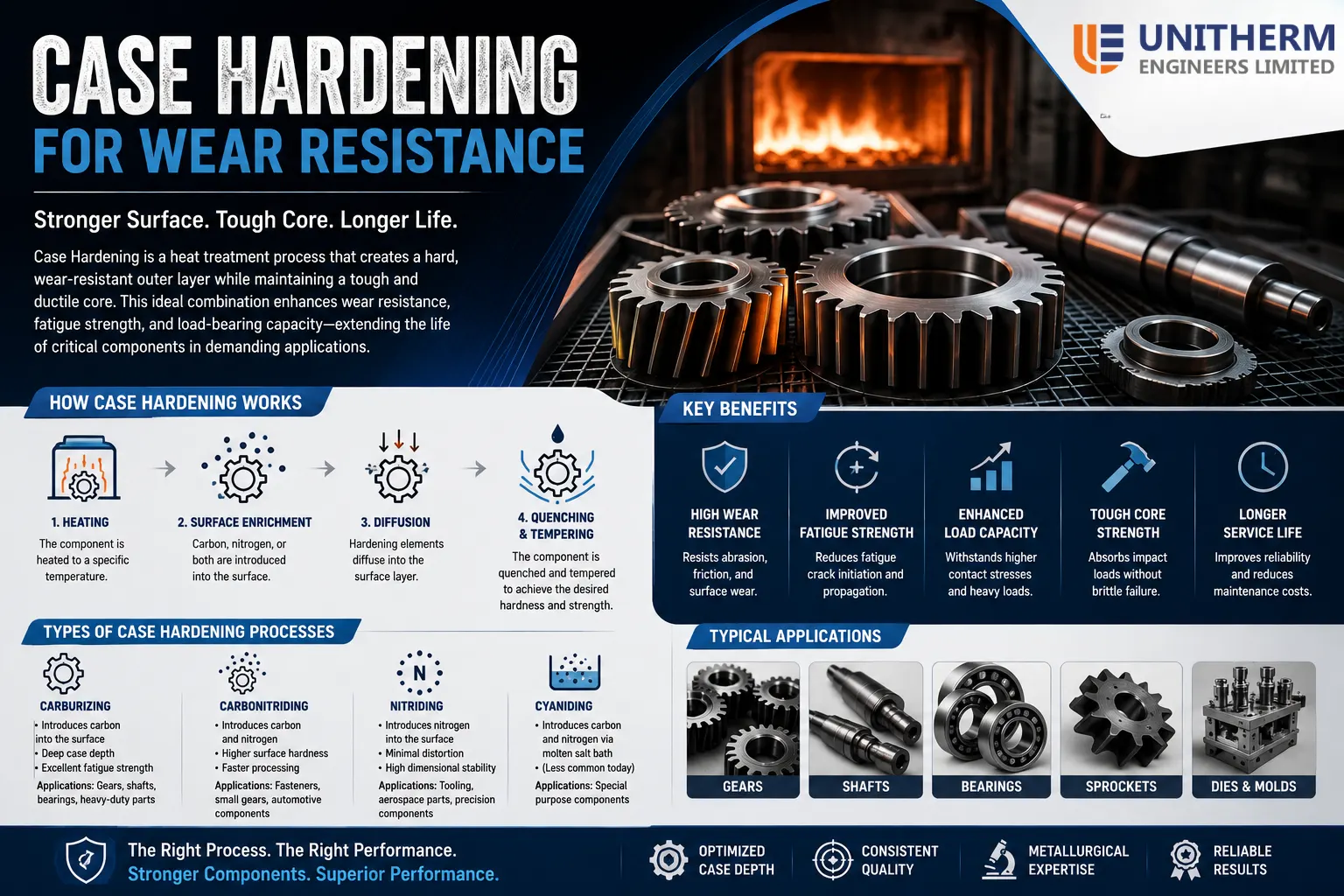
heat treatment process creates a hard, wear-resistant outer layer while maintaining a tough and ductile core. The result is a component capable of resisting abrasion, fatigue, and impact loads simultaneously. From
automotive gears and bearings to industrial machinery and mining equipment,
Case Hardening plays a critical role in extending component life and improving overall performance.
What is Case Hardening?
Case Hardening is a
heat treatment process that increases the hardness of a component's surface while preserving the toughness of its interior. Unlike through hardening, which hardens the entire component, case hardening modifies only the outer layer or "case.".
The
hardened surface provides excellent resistance to wear and contact stress, while the softer core absorbs shock and impact loads. This combination is particularly important for components that experience repeated loading and surface friction.
The process is widely used for steel components that require:
-
High wear resistance
-
Improved fatigue strength
-
Enhanced load-bearing capacity
-
Longer service life
-
Better reliability under harsh operating conditions
How Case Hardening Works
The
case hardening process involves introducing hardening elements such as carbon or nitrogen into the surface layer of steel.
The typical process includes:
Heating
The component is heated to a specific temperature suitable for diffusion.
Diffusion
The hardening elements diffuse into the material surface, creating a chemically modified layer.
Quenching and Tempering
Depending on the process, components may be quenched and tempered to develop the desired microstructure and hardness.
The resulting hardened case protects against wear, while the core remains strong enough to absorb mechanical stresses.
Types of Case Hardening Processes
Several methods are used to achieve case hardening depending on component requirements.
Carburizing
Carburizing introduces carbon into the steel surface at elevated temperatures.
Advantages:
- Deep case depth
- Excellent fatigue strength
- Superior wear resistance
Applications:
Carbonitriding
Carbonitriding introduces both carbon and nitrogen into the surface.
Advantages:
- Higher surface hardness
- Faster processing cycles
- Improved hardenability
Applications:
Nitriding
Nitriding introduces nitrogen into the steel surface without requiring quenching.
Advantages:
Applications:
- Tooling
- Aerospace parts
- Precision components
Cyaniding
Although less commonly used today, cyaniding introduces carbon and nitrogen through molten salt baths. Due to environmental and safety concerns, it has largely been replaced by modern alternatives.
Microstructure Development in Case Hardening
The effectiveness of
Case Hardening depends heavily on the microstructure formed during the
heat treatment process. Hardened Case Layer
The outer surface typically develops:
- Martensite
- Carbides
- Nitrides
- High hardness zones
These
microstructural features improve resistance to abrasion, contact wear, and fatigue.
Tough Core Structure
The core remains relatively softer and more ductile, allowing it to absorb shock loads without fracturing.
This combination provides an ideal balance of:
- Surface durability
- Impact resistance
- Mechanical strength
Microstructure control is essential for achieving consistent performance and maximizing component life.
Why Case Hardening Improves Wear Resistance
Wear occurs when material is gradually removed from a surface due to friction, abrasion, or repeated contact.
Increased Surface Hardness
A hardened surface resists scratching, abrasion, and deformation, significantly reducing wear rates.
Reduced Frictional Wear
The hardened case maintains its geometry under load, improving contact performance and reducing surface degradation.
Enhanced Fatigue Resistance
Repeated loading often causes fatigue cracks to initiate at the surface. The hardened layer helps resist crack formation and propagation.
Better Load-Carrying Capacity
Case-hardened components can withstand higher contact stresses, making them suitable for demanding industrial applications.
The result is longer component life, improved productivity, and lower maintenance costs.
Applications of Case Hardening
Case hardening is widely used across various industries.
Automotive Industry
- Transmission gears
- Differential gears
- Camshafts
- Drive shafts
These components require high wear resistance and fatigue strength.
Tooling Industry
Case hardening improves durability and reduces tool wear.
Industrial Equipment
- Bearings
- Rollers
- Sprockets
- Conveyor components
These parts benefit from increased service life and reliability.
Agriculture and Mining
Heavy-duty equipment operating in abrasive environments relies heavily on case-hardened wear components.
Case Hardening vs Through Hardening
Understanding the difference between case hardening and through hardening helps manufacturers select the right process.
| Parameter |
Case Hardening |
Through Hardening |
| Hardness Distribution |
Surface only |
Entire component |
| Core Toughness |
High |
Lower |
| Wear Resistance |
Excellent |
Moderate |
| Impact Resistance |
Superior |
Limited |
| Typical Applications |
Gears, shafts, bearings |
Cutting tools, springs |
Case hardening is preferred when both wear resistance and toughness are required simultaneously.
Common Challenges in Case Hardening
Despite its advantages, case hardening requires precise process control.
Distortion
High temperatures and quenching can cause dimensional changes.
Decarburization
Loss of surface carbon can reduce hardness.
Cracking
Excessive quenching stresses can lead to surface cracks.
Retained Austenite
Improper cooling may leave unstable microstructures that affect performance.
Regular process monitoring and metallurgical testing help prevent these issues.
Factors Affecting Case Hardening Quality
Several variables influence the success of a
case hardening process:
- Material composition
- Furnace atmosphere control
- Carbon potential management
- Temperature uniformity
- Heating cycle duration
- Cooling rate
- Quenching method
Maintaining strict control over these factors ensures consistent hardness, case depth, and microstructural integrity.
Choosing the Right Case Hardening Process
Selecting the appropriate process depends on:
- Component geometry
- Required case depth
- Wear conditions
- Fatigue requirements
- Production volume
- Cost considerations
For deep case applications, carburizing is often preferred. For precision components requiring low distortion, nitriding may be the better option. Carbonitriding offers a balance between performance and production efficiency.
A metallurgical evaluation can help determine the most suitable process for a specific application.
Benefits of Professional Heat Treatment Services
Working with experienced heat treatment specialists offers several advantages:
- Consistent hardness results
- Optimized case depth
- Improved component life
- Reduced maintenance costs
- Advanced metallurgical support
- Reliable quality assurance
Professional process control ensures that components achieve the desired performance characteristics while minimizing production risks.
Conclusion
Case Hardening remains one of the
most effective heat treatment methods for improving wear resistance and extending component life. By creating a hard, durable surface while maintaining a tough core, case hardening provides the ideal combination of strength, durability, and reliability.
Whether used in automotive gears, industrial machinery, tooling, or mining equipment, case-hardened components deliver superior performance under demanding operating conditions. With proper process selection, atmosphere control, and metallurgical expertise, manufacturers can significantly improve product quality, reduce maintenance costs, and maximize equipment lifespan.
FAQs-Case Hardening for Wear Resistance
1.What is case hardening?
Case hardening is a heat treatment process that creates a hard, wear-resistant outer surface while maintaining a tough and ductile core. This combination improves durability, fatigue strength, and resistance to mechanical wear.
2.Why is case hardening important for wear resistance?
Case hardening increases surface hardness, allowing components to withstand abrasion, friction, and contact stress. The hardened outer layer protects against wear, while the softer core absorbs impact loads and prevents brittle failure.
3.What are the most common case hardening processes?
The most widely used case hardening processes include:
- Carburizing
- Carbonitriding
- Nitriding
- Cyaniding
Each method offers different advantages depending on the required hardness, case depth, and application.
4.What materials can be case hardened?
Case hardening is commonly applied to:
- Low-carbon steels
- Alloy steels
- Tool steels
- Gear steels
The process is particularly effective for materials that require a hard surface and a tough core.
5.How does case hardening differ from through hardening?
In case hardening, only the outer surface is hardened while the core remains tough and ductile. In through hardening, the entire component is hardened uniformly. Case hardening is preferred for parts that require both wear resistance and impact strength.
6.What industries use case hardening?
Case hardening is widely used in:
- Automotive manufacturing
- Aerospace engineering
- Tool and die production
- Mining equipment
- Agricultural machinery
- Industrial power transmission systems
Common applications include gears, shafts, bearings, sprockets, and wear-resistant components.